Introduction
With PerfTrak, you can configure a schedule of planned shutdowns assigned to the machines of your choice. This schedule is not only a visual planning tool: it directly affects how time is processed. The losses corresponding to the shutdown period are informed automatically, according to the processing mode you choose.
Use case
You schedule recurring or one-off shutdowns — maintenance, breaks, plant closure — and you want the corresponding durations to be qualified automatically in the history, without any action from the operator.
A planned shutdown is defined in a calendar with a start date, an end date and the loss headings (levels 0, 1 and 2) associated with that type of shutdown. Those headings are informed automatically over the period covered.
The deltas (tolerances)
In reality, the beginning and the end of a stoppage rarely match the configured times to the nearest second. Deltas are "buffer" tolerance zones located around the boundaries of the planned shutdown: shutdown detection still works even if one or more impulses (events) are received during those zones.
There is only one type of delta, with a single duration shared between four time zones:
Anterior and posterior deltas (outside the planned shutdown)
Located just before and just after the planned shutdown. They are associated with a duration and with a pre-configured loss type — which may be that of the planned shutdown or another loss type, depending on your choice.
First inner and second inner deltas (within the planned shutdown)
Located inside the planned shutdown, at the beginning and at the end of the period, with the same duration as the outer deltas. These inner deltas only apply to standard mode. Unlike the outer deltas, they are never informed under the heading chosen for the delta: they are informed directly under the loss heading of the planned shutdown.
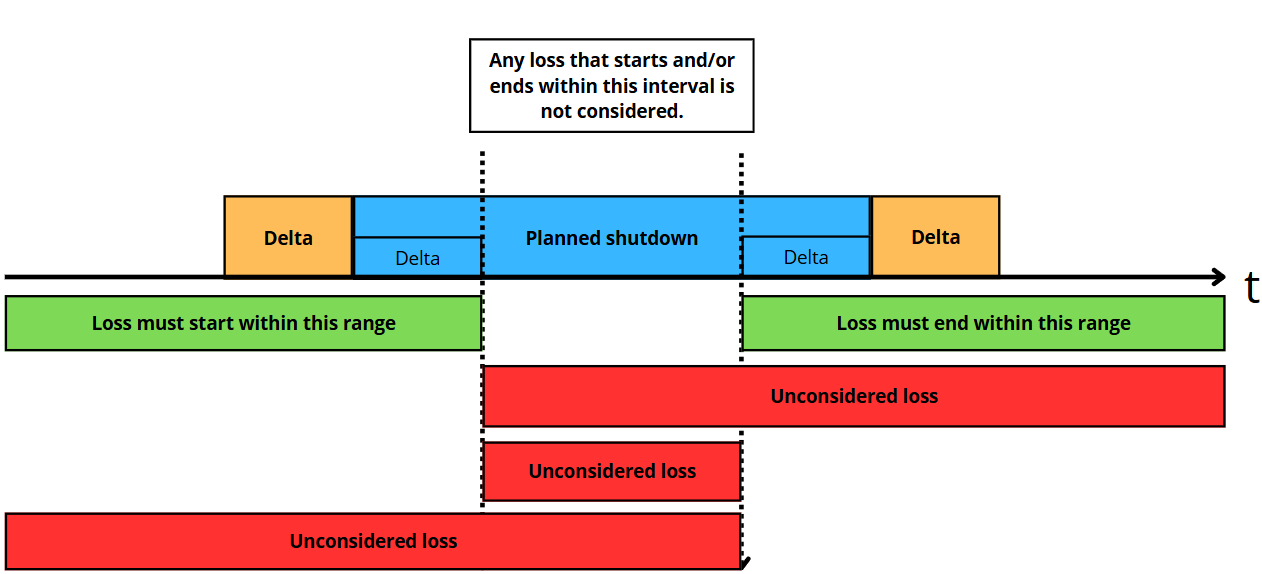
In orange: the automatic information of the deltas, under the heading chosen for the deltas. In blue: the heading of the planned shutdown itself.
Duration qualification rules
Downtime periods covering a delta or a planned shutdown are automatically qualified according to the associated loss causes.
- If a loss covers several parts of the planned shutdown, the system splits the duration at the start boundaries of the deltas and of the planned shutdown.
- Losses are qualified automatically, but the operator always has priority: they can intervene and change the information at any time.
- A loss qualified manually by the operator is never replaced by the loss causes associated with a planned shutdown.
Splitting rules:
- At each split in the anterior and first inner deltas, the "left" side — the past — keeps its existing information.
- At each split in the posterior and second inner deltas, the "right" side — present to future — is updated with the loss cause of the segment being processed.
The three modes
How a planned shutdown behaves when impulses occur depends on the mode you choose in the "Mode" selector:
| Mode | Behaviour |
|---|---|
| Standard | The planned shutdown is only detected if a continuous stoppage covers the whole period. An impulse during the planned shutdown ends the detection. |
| Listen events | Impulses are taken into account and generate normal time, without invalidating the detection of the planned shutdown. |
| Ignore events | Impulses are ignored during the planned shutdown: the shutdown prevails entirely. |
Each mode is detailed in its own article.
Prerequisites
- Set a single duration for the deltas and assign them a loss type that allows them to be informed automatically — see the article "Configuring a planned shutdown step by step".
- PerfTrak must remain open throughout the detection of the planned shutdowns.
- In standard mode, do not use the "Stop Production" button and do not launch a task during the period: these actions deactivate the detection of the planned shutdown.
FAQ
Can I set different delta durations for each zone?
No. A single duration applies to the four zones — anterior, posterior, first inner and second inner.
What happens if the operator has already informed a loss over the period?
It is kept: manual qualification always takes priority over automatic information.