Introduction
The MTBF and MTTR KPIs are two reliability and maintainability indicators, displayed in real time on your dashboard. They are based on the machine stoppages recorded in your loss tree, and measure — over a given interval — the robustness of your equipment and the responsiveness of your maintenance.
MTBF (Mean Time Between Failures) is the average duration of uptime between two consecutive failures.
MTTR (Mean Time to Repair) is the average repair time of the machine.
Each of these indicators comes in two configurable scopes:
Machine MTBF / MTTR: the indicator is calculated on a single reference machine.
Workshop MTBF / MTTR: the indicator takes into account every machine in a workshop, selected from the workshop drop-down list.
Example use cases
Reliability tracking of a critical machine — A maintenance manager wants to follow the reliability of a strategic press. They create a Machine MTBF KPI on that press, to measure the average uptime between two breakdowns and detect any degradation over the weeks.
Steering the maintenance of a workshop — A workshop manager configures a Workshop MTBF KPI to get a consolidated view of the reliability of all their machines, and prioritise preventive maintenance actions.
Measuring maintenance responsiveness — A production manager creates a Machine MTTR KPI to follow the average time to restart after a stoppage, and challenge their team's intervention times.
Comparing lines — A manager displays a Workshop MTBF and a Workshop MTTR side by side, to identify the least reliable workshops (low MTBF) and those where repairs take longest (high MTTR).
Understanding the calculation
MTBF formula
The MTBF is the average duration of uptime between two consecutive failures.
MTBF = Σ Uptime / Number of failures (or number of uptime periods)
In practice, the system subtracts planned downtime and breakdowns from the total time, to obtain the machine's actual operating time. That time is then divided by the number of breakdown occurrences, which gives the MTBF over the chosen period:
MTBF = (Total time − (Breakdown time + Deliberate or planned downtime)) / Number of breakdowns
MTTR formula
The MTTR is the average repair time of the machine.
MTTR = Total machine downtime / Number of occurrences of losses due to machine downtime
During the configuration, you choose from an exhaustive list the losses to be considered as breakdowns or failures. The MTBF / MTTR calculations are then performed automatically, based on the loss types you selected.
Creating and configuring an MTBF or MTTR KPI
Step 1 — Create the KPI
Go to your dashboard.
Click Add New KPI, select PERFTRAK machine as the machine type, then choose the KPI type that matches your need:
Machine MTBF indicator or Machine MTTR indicator for a single machine,
Workshop MTBF indicator or Workshop MTTR indicator for a whole workshop.
Step 2 — Enter the name
In the Name field, enter the title of your indicator as it will appear on the dashboard.
Step 3 — Select the machine or the workshop
For a machine indicator: select the reference Machine.
For a workshop indicator: select the Workshop from the drop-down list. The indicator then takes into account every machine in that workshop.
Step 4 — Choose the interval
In the Interval field, choose the calculation period you want (for example Last hour, Last 7 days). The average is calculated over that period.
Step 5 — Select the loss categories
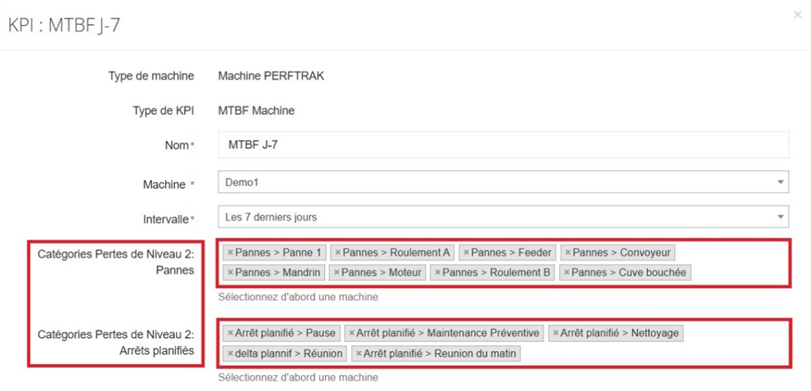
This is where the real configuration of the indicator happens. You designate the loss types that must be considered as breakdowns or stoppages.
The level of the loss tree used depends on the scope of the indicator:
Workshop indicator → Level 1 loss categories,
Machine indicator → Level 2 loss categories.
For an MTBF: select the two expected loss families:
Loss categories: Breakdowns — the losses corresponding to breakdowns and failures,
Loss categories: Planned downtime — the losses corresponding to deliberate or planned stoppages.
The system can then subtract both planned downtime and breakdowns from the total time, to obtain the actual operating time, and divide it by the number of breakdown occurrences.
For an MTTR: select the loss type related to the MTTR calculation, choosing among the loss categories — Level 1 for the workshop, Level 2 for the machine. The total duration of those stoppages is divided by their number of occurrences.
Note — As long as no workshop (or machine) is selected, the loss category lists display "Select a workshop first" and stay inactive. Complete step 3 first.
Step 6 — Save
Click Save to add the indicator to your dashboard, or Cancel to abandon the creation.
Reading the KPI
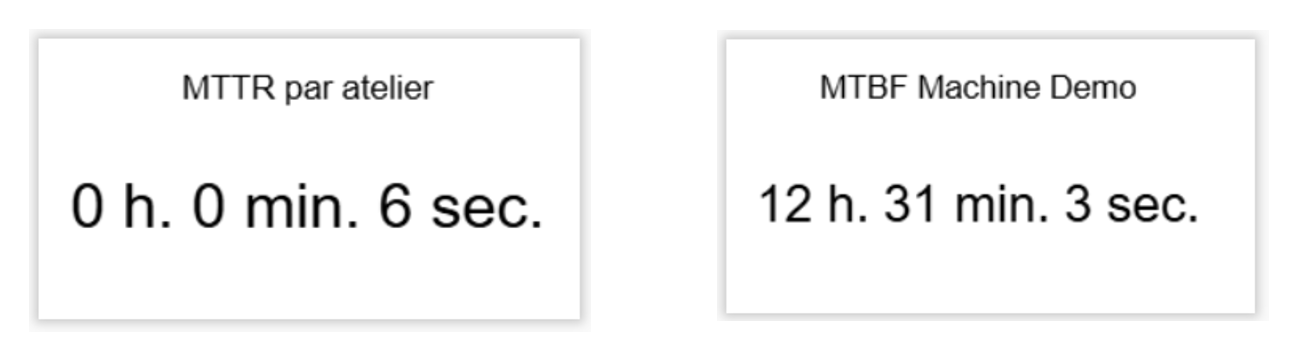
Once configured, the indicator appears as a tile on your dashboard. It shows the KPI name and the average value, expressed as a duration (hours, minutes, seconds).
A high MTBF means long periods of uptime between two breakdowns: the higher it is, the more reliable the machine (or the workshop).
A low MTTR means fast repairs: the lower it is, the more responsive the restart after a stoppage.
The indicator updates automatically from the losses recorded over the chosen interval.
Edge cases and points to watch
The quality of the calculation depends on the loss tree. Only the losses you select in step 5 are taken into account. An incomplete or incorrect categorisation of stoppages directly distorts the MTBF and the MTTR.
MTBF: remember to fill in both loss families. If you leave out planned downtime, the uptime is overestimated — deliberate stoppages are counted as operating time — which distorts the MTBF.
Machine / workshop consistency. For a workshop indicator, make sure you select the losses at Level 1; for a machine, at Level 2. The wrong level can lead to an empty or inconsistent selection.
A workshop indicator is an aggregation. The workshop MTBF / MTTR consolidates every machine in the workshop: the value displayed is an overall average and does not reflect the behaviour of one particular machine.
No breakdown over the period. If no breakdown occurrence is recorded over the interval, the MTBF has no divisor.
FAQ
What is the difference between MTBF and MTTR? The MTBF measures the average uptime between two breakdowns (reliability). The MTTR measures the average repair time after a stoppage (maintainability). The two are complementary: a piece of equipment may break down rarely (high MTBF) but take a long time to repair (high MTTR), and vice versa.
What is the difference between a "machine" and a "workshop" indicator? The machine indicator is calculated on a single reference machine. The workshop indicator aggregates every machine in the selected workshop and provides a consolidated average value.
Why do I have to select two loss categories for the MTBF (breakdowns and planned downtime)? To isolate the actual uptime, the system must subtract from the total time both the breakdowns and the deliberate or planned stoppages. The breakdowns also serve as the divisor (number of failures). Designating both families is therefore what makes the calculation correct.
Which loss level should I select? Level 1 for a workshop indicator, Level 2 for a machine indicator.
How often is the indicator updated? The indicator is recalculated automatically from the losses recorded over the chosen interval.
What happens if I modify my loss tree after creating the KPI? The calculation relies on the loss categories selected during the configuration. If you reorganise your loss tree, check that the categories chosen for the MTBF / MTTR are still valid and still match the expected breakdowns and stoppages.